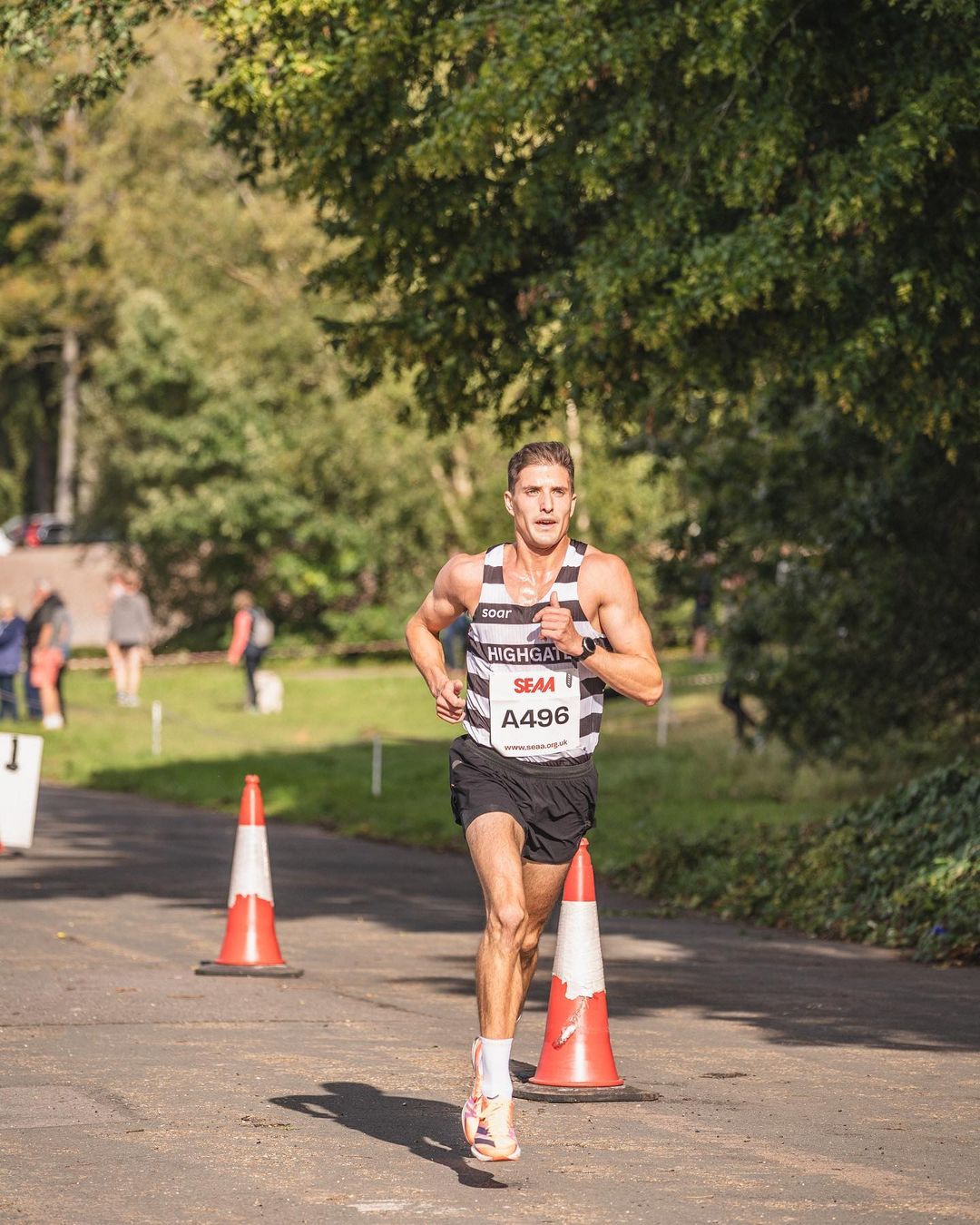
Alex Milne was 18 years, one month and two days old when he stood on the startline of the London Marathon for the first time. The leaders long gone by the moment the then Hillingdon man passed the timing mat, on his quest for sub-three.
Up front Martin Lel took 23 seconds off the course record. He held off a 21-year-old Samuel Wanjiru, months away from his own zenith as Bejing’s Olympic Champion.
Milne, behind, toiled in the rain. Brutalised by the marathon, endeavour and ambition couldn’t overcome the physical challenge of 26.2 miles. Sometimes running, sometimes walking, Milne came home in 3:30:20, the 4,317th finisher of the 28th London Marathon.
18 years later, I sit down with a Maths teacher, father of one and clubmate, who more or less hasn’t stopped since.

World Champion and European Record holder
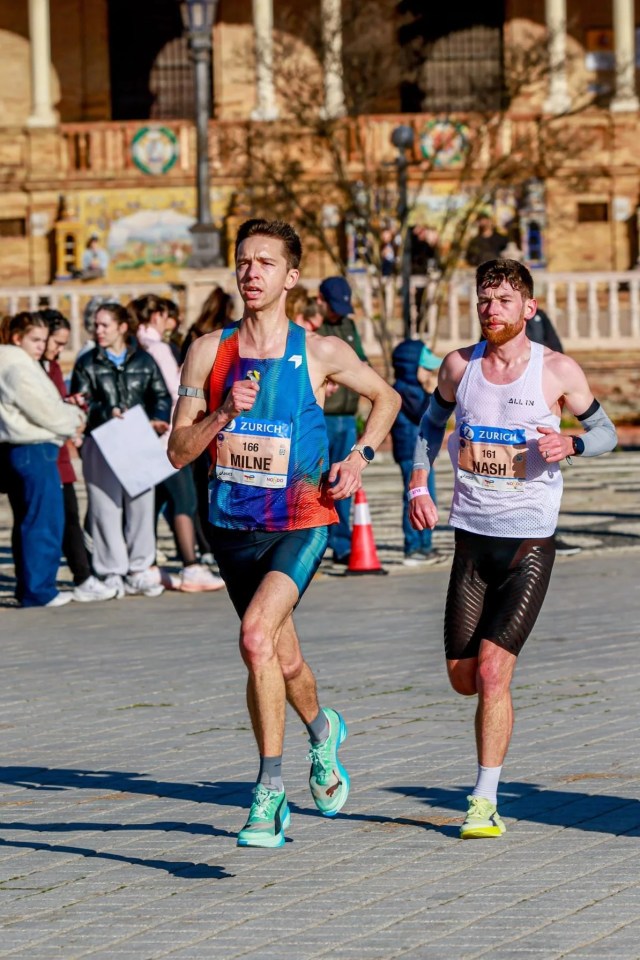
Earlier this year Milne ran 2:11:41 (2:11:44 gun time) at the Seville Marathon and sits 57th on the UK all-time rankings. A month later he broke the European record (2:46:09) to win the World 50km Championships in New Delhi. And just a few months after that, he broke Leonid Shvetsov’s 2008 Comrades Marathon course record, as he finished fourth in perhaps the world’s most competitive long-distance race.
We’ve been fortunate to speak to Eliud Kipchoge, Sifan Hassan, Geoffrey Kamworor and many of Britain’s best over the years but there’s something far more inspiring, in this author’s eyes, in an athlete who’s success sits a bit closer to home. An athlete, who has slowly meandered his way from good to the cusp of the extraordinary, surrounded each day by the mundane realities of working life.
The early marathon days
Milne returned to Blackheath in 2009, again with the ambition of an elusive sub-three. A nascent running scene, social media’s non-existence meant the race was still the preserve of the hardy, self-motivated running aficionados. Paper training diaries and routes planned on Map My Run , whilst he fell short of his goal, Milne was still discovering the joy of analysed self-improvement. For a maths teacher, who would years later take a pretty exact approach to his training, it was always likely to be a match.
He ran 3:22:13 for 3,025th, again finding himself walking large periods, before he achieved the feat on his third effort. Still aged barely 20, he ran 2:39:26 for 160th.
“It took me a long time to get the marathon properly right. In 2010, the first time I went under three hours (2:39) I was happy with that. I trained pretty hard for it!” He recalls, all those years later.
Milne saw running sub-three as a big step at the time, even if his 69:41 over the half later that year indicated it was a formality. In simple, perhaps brutal terms, as a distance Milne was not yet good at the marathon, at least compared to what other events might indicate.

Accumulated experience
He did not return to the distance for four years, trying his hand at triathlon in 2012 and 2013 and competing regularly over the grass and mud, often to mixed success.
“I’d race the properly quick guys over cross-country and be so far back and just think, Okay, I’m clearly not cut out for the sport.”
A lot of athletes naturally get drawn to their strengths, or, better put, don’t stick at their weaknesses for long enough to find out anything else. Inevitably Milne always returned. The 36-year-old’s personal life has drawn him over most of the south-east, seeing him compete in the Metropolitan, Surrey and Hampshire Cross-Country Leagues, as well undertaking a PGCE at Cambridge University in 2015. He twisted his ankle in the dying moments of that year’s Varsity and couldn’t finish as Oxford won by a whisker.
Milne’s skill, alongside a work ethic that most top athletes inevitably have, seems to be to take something from each experience. To tailor his training from each disappointment or success and slowly fine-tune how he approached the rest. An example of that in recent years was the 2024 World 100km Champs. There in Bangalore, he was first properly introduced to the science behind heat training.
A few last minute hot baths (even two nights before the race) failed to save him, even if a seventh place by others measures was a success. Two years later, before the World 50km, again in India, Milne had honed his 30 minute baths at 40 degrees. Five nights straight for two weeks. When I chuckled at this thought, Milne was quick to put me straight:
“It seems to keep my heart rate lower for a certain effort level.”

Pushing all the levers
Those experiences have remained broad throughout his running life. Milne raced 43 times in 2014, far from advised behaviour but its hard to not, in hindsight, see some benefit to the madness. From breaking two minutes on the track at Watford, Milne raced all the way up to the marathon, lowering his best to 2:25:14 as he finished 31st in a pre-super shoes London.
Obviously not maximising his results at any event, he regardless pushed all the levers. Speed, strength and stamina.
Progression, on review, was something approaching linear, but at no point did Milne pivot to those events in which he enjoyed more joy, not yet at least. He continued to race across his self-professed “weaker” disciplines.
Milne was 26 when he first cracked the top-30 at the South of England Cross-Country Championships, 27 when he was 58th at the 2018 National Cross Country, and though in recent years he has performed outstandingly on all surfaces (he was fourth at the Southern Cross Country in 2025 and won the individual title at the 2025/2026 Surrey Cross-Country League), change and adaption took persistence and time. Milne simply kept going.

Years compounded not single blocks
Milne’s 2:25 run in 2014 led to the Hercules Wimbledon man reassessing what he wanted to have achieved when all was said and done. The first was breaking 2:20, an absolute lifetime goal. For a few years his results discovered some regularity. A few personal bests sprinkled throughout, there would be times where he would go backwards over other distances.
It would take five years until he started to take a major leap forwards. Increasing his mileage reasonably significantly, he moved from a monthly peak of c. 550km to 640km in 2019. Aged 29 he surprised himself by running 2:21:15 in Brighton and 2:20:08 in London, just two weeks apart. The later saw him finish fourth in the Championship race and he was selected for the Great Britain team for the World 50km, where he finished 15th in 2:56:20.
Yet he we would still be 32 before that lifetime goal finally fell as he ran 2:17:53 in Manchester in 2022.

Enter Comrades
The other lifetime goal remained. Before Milne knew much about running, he knew about the Comrades Marathon. His South African physics teacher talked more about the event than he did the subject. Milne knew that eventually he would race between Pietermaritzberg and Durban.
“I knew one day I wanted to try and complete the race.” Milne recalls, matching the goal of the overwhelming majority of those on the starting line-up. Ambitions beyond, for a race with more than 1700m of elevation over 90 kilometres, seem to tempt fate.
His first attempt to do so came in 2023. Six weeks before Milne had lowered his marathon best to 2:16 at London but this was still almost 40km more than his longest distance. The goalposts quickly moved as he finished 15th on debut. Top ten was now the goal as he returned the next year.

Top-ten tilt
“Before the race I was thinking, okay, I’ve got a chance to make the top ten. And then you’re running along and you’re halfway through and there’s sixty guys ahead of you. The pack is actually out of sight. I was just thinking to myself, yeah, there’s no way it’s going to happen this year.”
That 2024 race was in many ways an echo of Milne’s life in running. At two hours in Milne was 76th. At almost 56k he still sat outside the top 30.
“I think I broke into the top ten with about 12km to go.” Almost unheard of in the race, Milne continued to get quicker throughout the second half, eventually finishing ninth. It’s an approach he’s maintained each time as he’s climbed higher. First to sixth in 2025 and this June, to fourth, a full 13 minutes quicker than his 2024 time.

Neurotic specificity
Milne’s progress has not been through persistence alone. A strong advocate of bicarb and nomio, his step up in distance has been followed with a neurotic focus on the controllables. He has continued to push his carb intake and in his build for the upcoming World 100km Champs you might have spotted him doing metronomic and monotonous lap after lap in Battersea Park. There’s a good chance you did as his most recent run was 65km and took four hours, all on the same 2.7km loop.
Before his latest Comrades attempt, Milne took a novel approach to the race’s demands. Heading regularly to Denbies Vineyard, Milne regularly did sapping runs over that particular testing section of the North Downs Way. Back and Forth between the tops of Denbies and Box Hill, Milne worked hard for four hours. He averaged just over six minute miles with almost 1400m of elevation.

Persist and adapt above all else
These are the icing on top, the eye-catching runs that seem to separate Milne from the rest. The runs that make the man following on Strava think this man is built different.
But these runs only tell the smallest part of the story. Milne has, ever since those first steps walking down the Embankment, consciously built himself different.
He has persisted, embraced, and confronted his own weaknesses and forced them to become his strengths.
When Milne was a worse runner, he said poor runs weighed heavier and getting beaten by others annoyed him more. That obviously hasn’t fully gone away but there’s undoubtedly less emotion in his approach 18 years on.
Yet putting emotion and ego to the side has unlocked the most romantic of achievements that a young Milne could simply never have contemplated.
Keep going. Keep learning. Keep losing. Something good is on the other side.
Enjoy this one? Why not subscribe below for free
Featured image by George Parker.